History
The idea for the coastal water trail that would eventually become the Maine Island Trail was born in the late 1980s, following a land survey of uninhabited coastal islands conducted by the State of Maine. The survey determined that the State held title to some 1,300 unclaimed islands, rocks, ledges, and low-water bars along the coast. In the mid-1980s, the State collaborated with the Island Institute, a nonprofit organization that serves the islands and island communities of the Gulf of Maine, to evaluate the recreational potential of these properties.
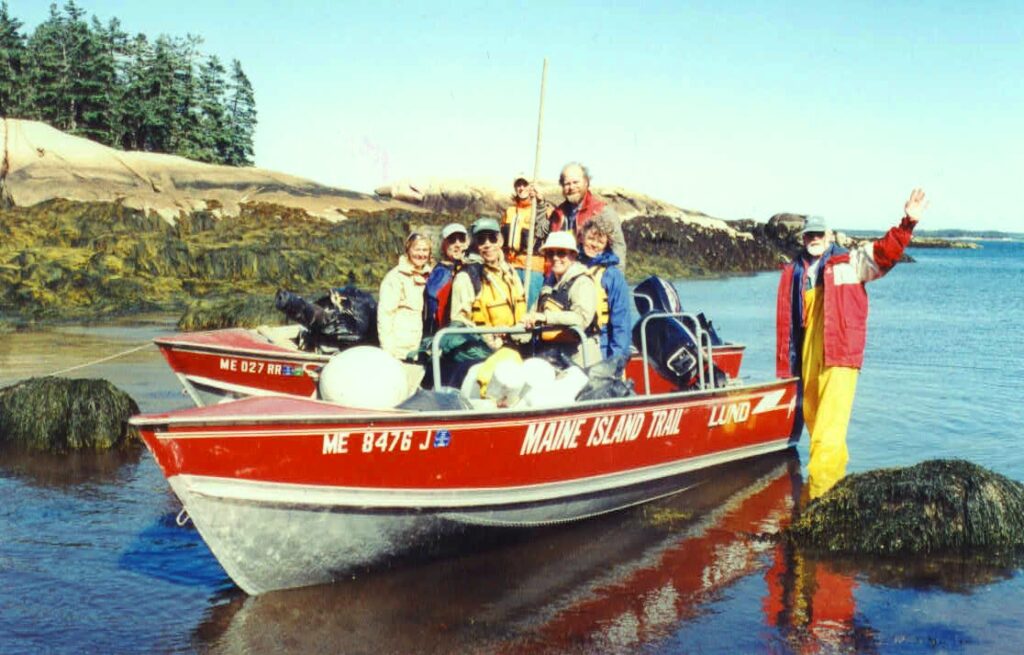
As part of this evaluation, MITA’s founder, Dave Getchell, Sr., explored the length of the coast and identified approximately 40 islands suitable for recreational use. Many of these would become the original 30 islands that formed the first iteration of the Maine Island Trail.
In the fall of 1987, Getchell Sr. declared in an editorial column in Small Boat Journal that “In studying this bounty [of islands], it occurred to me that here was a rare chance to develop an outstanding waterway for small boats that would use the state-owned islands for overnight stops, similar to the way hikers use pathways like the Appalachian Trail.” This was an early inception of what recreational boaters today call a water trail—a concept that has been replicated over 500 times in North America.
During this early contemplation of the Trail, concern was expressed that widespread and unchecked visitation could damage the natural integrity of these fragile coastal islands. Considering this possibility, Getchell Sr. wrote a proposal to the Maine Bureau of Parks & Lands and L.L. Bean in 1988 for modest seed money to create a “Maine Island Trail Association” that would be charged with stewarding the Trail islands. The proposal was funded, establishing a partnership that the Maine Bureau of Parks & Lands and L.L. Bean continue to support to this day. The Maine Island Trail Association (soon to be known commonly as MITA) was official.
As the Trail swelled in size and popularity, MITA’s significance grew—and so did its divergence from the core mission of the Island Institute. In 1993, MITA became an independent nonprofit entity of its own. MITA made the move from Rockland to establish an office in Portland, and has continued to evolve while remaining centered on its mission of promoting responsible island recreation and stewardship.
Today, MITA boasts some 9,500 active members, all of whom play a role in maintaining the Trail and its network of over 200 sites. This includes lending support through membership fees and donations or performing stewardship work as MITA volunteers. As the Maine Island Trail and MITA have evolved, so have the organization’s initiatives to do even more to carry out our mission.
While still guided by the founding principle of stewardship through recreational access, MITA continues to grow and find new ways to do more for our members, our land-owning partners, and the Trail. We can confidently say that we are as excited for our future as we are proud of our history.